
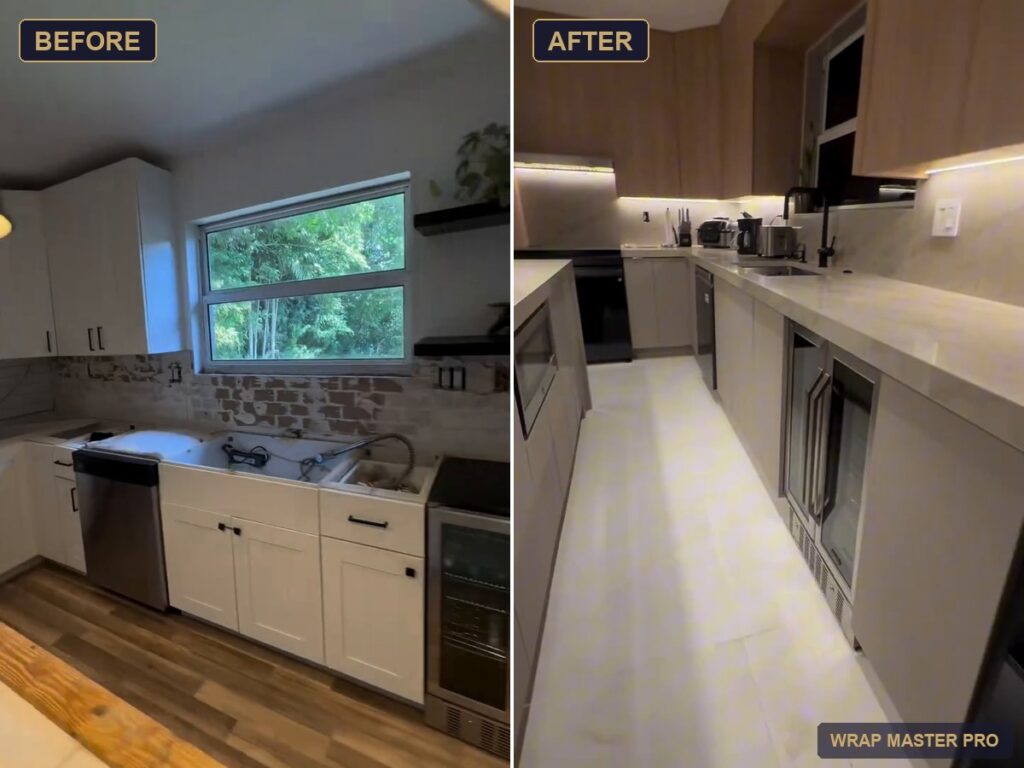
Peeling thermofoil is one of the most common problems we see in South Florida kitchens. It usually starts at a corner next to the oven or above the dishwasher: the smooth white film lifts, bubbles or curls away from the door, and once it starts, it keeps going. Laminate cabinets have their own version of the problem, with chipped edges, faded surfaces and edge banding that comes loose.
The good news is that these kitchens are often excellent candidates for refacing. The cabinet boxes behind those doors are usually still solid, and the damage lives on the surface. This guide explains what thermofoil and laminate are, why they fail, when the boxes can be kept, and how to decide between a Kitchen Color Update and new acrylic doors.
What thermofoil and laminate actually are
Thermofoil is a thin vinyl film that is heated and pressed over a door made of MDF (medium-density fiberboard). Because the film is soft when it is applied, it can wrap around routed shapes, which is why so many thermofoil doors have a raised or recessed panel design. From a distance it looks like painted wood, which made it a popular choice for builder-grade kitchens for many years.
Laminate is a harder decorative layer bonded to particleboard or MDF. It is usually found on flat, slab-style doors, often with a separate edge band glued around the perimeter. It was common in condos and older kitchens.
Both materials share one weakness: they depend on adhesive. When the glue fails, the surface fails.
Why thermofoil peels near heat
The adhesive that holds thermofoil to the door is sensitive to heat. Every time the oven is on, the self-cleaning cycle runs, or the dishwasher releases a cloud of hot steam when it opens, the doors next to those appliances absorb that heat. Over time the bond weakens and the film starts to separate. That is why peeling almost always begins in the same places:
- Doors and drawer fronts directly beside the range or wall oven.
- The sink base and the cabinets on either side of the dishwasher.
- Upper cabinets above the stove or a toaster oven.
Florida humidity does not help. Moisture that gets behind a lifted edge can swell the MDF core, and at that point the door itself is damaged, not only the film.
When the cabinet boxes are good enough for refacing
Refacing keeps your cabinet boxes, your layout, your plumbing, your countertops and your appliances. So the first question is not about the doors at all. It is whether the boxes behind them are sound. In most thermofoil and laminate kitchens, they are. Look for these signs:
- The frames are rigid. When you push on the side of a cabinet, it does not rack or flex.
- Shelves are level and the shelf supports are intact.
- The sink base is dry. No swelling, soft spots, stains or mold on the floor of the cabinet.
- Hinge areas are solid. Screws hold firmly and the material around them has not crumbled.
If one or two areas have water damage, that can usually be repaired before the new fronts go on. If the boxes are failing throughout the kitchen, refacing is not the right answer, and we will tell you so. Our guide to a kitchen remodel without demolition explains where that line falls.
Option 1: A Kitchen Color Update for flat doors in good condition
A Kitchen Color Update applies a new vinyl finish to your existing doors, on both sides. It keeps the door fronts you already have and gives the whole kitchen a new color or a woodgrain look. You can learn more about the material on our vinyl wrap page.
This option has two firm conditions: the doors must be flat, and they must be in good condition. That makes it a good fit for many laminate kitchens, where slab doors are often structurally fine but the color looks dated. It is usually not a fit for peeling thermofoil, for two reasons:
- Most thermofoil doors have a raised or shaped panel, not a flat face.
- A new finish needs a stable surface underneath. If the old film is lifting or the MDF has swollen, that surface is no longer stable.
Option 2: New custom acrylic doors
When the doors are shaped, peeling, chipped or swollen, the better path is to replace them. With Premium Acrylic Refacing, our most popular option, we remove the old doors and drawer fronts and install new custom-made acrylic doors in a flat, European-style design. The visible surfaces of the cabinet boxes are updated to match, old moldings are removed, and the package includes soft-close hinges and integrated pulls.
Acrylic is a very different material from thermofoil. The surface is sealed and non-porous, it resists humidity, it cleans with mild soap and a soft cloth, and it never needs to be repainted. You choose a matte or high-gloss finish; if you are undecided, read our comparison of matte vs. high-gloss acrylic cabinets.
For a side-by-side look at both materials, our page on acrylic vs. vinyl kitchen cabinets explains when each one makes more sense.
A quick way to decide
- Flat laminate doors, intact edges, no swelling: a Kitchen Color Update is likely an option.
- Flat doors with a few chipped edges: it depends on how many doors are affected. Photos tell us quickly.
- Raised-panel thermofoil, even if it is not peeling yet: new acrylic doors.
- Any door with peeling film or a swollen core: new acrylic doors.
Homeowner checklist before you request a proposal
This list helps you describe your kitchen and get a more accurate proposal.
- Identify the door style. Run your hand across the front. Is it completely flat, or is there a raised or recessed panel?
- Find the damage. Check the doors next to the oven, dishwasher and sink. Note any peeling, bubbling or lifted corners.
- Press on the edges. Soft, puffy or crumbling edges mean the core has absorbed moisture.
- Open the sink base. Look for swelling, stains or a musty smell.
- Test a few cabinets. Push on the frames and check that shelves sit level.
- Count your doors and drawers. A rough count helps the proposal.
- Decide what stays. Refacing keeps your layout and countertops. If you want to move walls or plumbing, you need a remodel.
- Take three photos: the full kitchen, the upper cabinets and the lower cabinets. Add a close-up of any damaged door.
How the process works
Send your three photos through our kitchen photo quote form. Our team reviews them and replies with a personalized proposal that includes a design recommendation, clear pricing and a schedule showing the production and installation dates. Once you approve, we confirm measurements at your home and your new doors are made to fit. Most kitchens are installed in three to five days, with no demolition, and you keep using your home throughout. Every project is backed by a written three-year warranty, and our team is fully insured.
We have transformed more than 500 kitchens across South Florida and hold a 4.9 rating on Google, with reviews that often mention punctuality, clear communication and work finished as promised.
Frequently asked questions
Can peeling thermofoil be glued back down?
It can be glued temporarily, but it rarely lasts. The heat that caused the peeling keeps working on the same doors, and moisture may already be in the core. Replacing the doors is the long-term fix.
Can you put a vinyl color update over thermofoil doors?
Usually not. A Kitchen Color Update requires flat doors in good condition. Most thermofoil doors have a shaped panel, and peeling film does not give a new finish a stable surface. New acrylic doors are the better choice.
Are laminate cabinet boxes strong enough to keep?
In most kitchens, yes. Particleboard and MDF boxes are fine for refacing as long as they are rigid, level and free of water damage. Isolated damage under the sink can usually be repaired first.
Will new acrylic doors peel like thermofoil?
Acrylic doors are a different product. The surface is sealed and non-porous, resists humidity and never needs repainting. Our work is covered by a written three-year warranty.
How much does it cost to reface laminate or thermofoil cabinets?
The price depends on the size of the kitchen, the number of doors and drawers and the finish you choose. Because the cabinet boxes stay, refacing costs a fraction of a full remodel. Send photos for a personalized proposal.
Find out what your cabinets need
Peeling or worn doors do not mean the whole kitchen has to go. Send us three photos and a close-up of the damage, and our team will tell you whether a Kitchen Color Update or new acrylic doors is the right fit, with clear pricing and a schedule.