
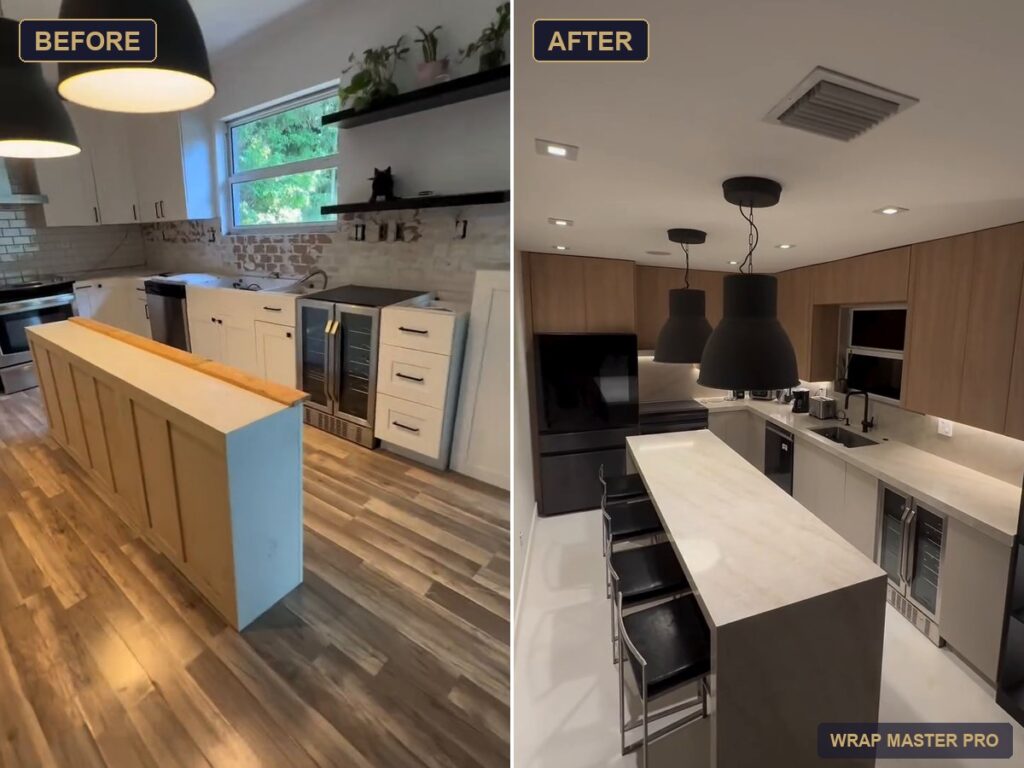
When a kitchen starts to feel dated, most homeowners picture two options: live with it, or tear it out and start over. There is a third path that sits between the two. Kitchen refacing keeps the structure of your kitchen and replaces what you see, while a full remodel rebuilds the room from the studs. Both can produce a beautiful kitchen, but they are very different projects to live through.
This guide compares the two honestly: how long each one takes, how much mess and disruption to expect, what stays and what changes, and when a full remodel really is the better choice. The goal is to help you pick the right project, not to talk you into ours.
What each project actually involves
Kitchen refacing
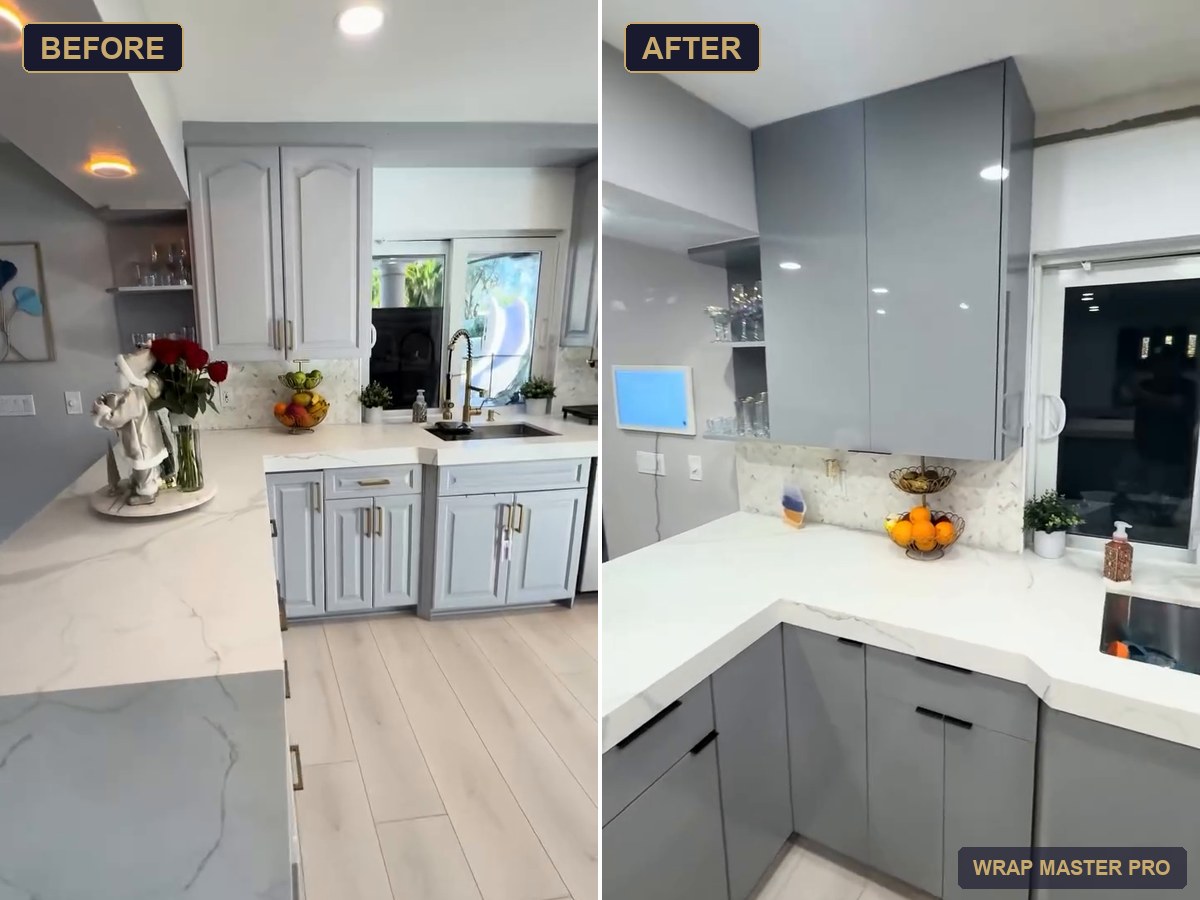
Refacing keeps your cabinet boxes, your layout, your plumbing, your countertops and your appliances exactly where they are. What changes is the surface. With our Premium Acrylic Refacing, the old doors and drawer fronts are replaced with new custom-made acrylic fronts in a flat, European-style design, in a matte or high-gloss finish. The visible surfaces of the cabinet boxes are updated to match, soft-close hinges and integrated pulls are installed, and dated moldings are removed. If your doors are already flat and in good shape, a Kitchen Color Update applies a new vinyl finish to both sides instead.
A full remodel
A full remodel usually starts with demolition. Cabinets come off the walls, countertops are cut out, and in many projects flooring, drywall, plumbing and electrical are changed too. New cabinets are built or ordered, new countertops are templated after the cabinets go in, and appliances are reconnected at the end. Several trades work in sequence, and each depends on the one before it.
Time: days versus a sequence of trades
With refacing, most kitchens are installed in three to five days. Your new doors and drawer fronts are made to the measurements of your kitchen before installation starts, and your proposal shows the production and installation dates up front, so you know what to expect before you commit.
A full remodel does not have a single installation window. Demolition, rough plumbing and electrical, inspections, cabinet installation, countertop templating and fabrication, backsplash and final connections all happen in order. When one step runs late, everything after it moves. That is why remodel timelines are usually described in weeks or months.
Dust, noise and demolition
Demolition is the part of a remodel that people underestimate most. Removing cabinets and countertops creates debris, dust that travels through the house and a lot of noise. There is usually a dumpster to manage, and floors and furniture need protection throughout.
Refacing has no demolition, so there is no heavy dust and no debris hauling. Our fully insured team protects your floors and countertops while we work. You can see the difference in our guide to a kitchen remodel without demolition.
Living at home during the work
For most families, this is the deciding factor. During a full remodel, the kitchen is often out of service for a long stretch. That means a temporary kitchen in the garage, a lot of takeout and dishes washed in the bathroom sink.
During refacing, you keep living in your home. Your sink, stove, refrigerator and countertops stay in place and keep working. There may be a few hours each day when certain cabinets are open, but there is never a point where the kitchen is gone. For busy households, that alone often settles the question.
Permits and structural work
A full remodel that moves walls, relocates plumbing or changes electrical circuits typically requires permits and inspections through your city or county. That adds paperwork and inspection visits to the schedule.
Refacing does not touch walls, plumbing or wiring. It works on the cabinets you already have, so it does not involve the structural, plumbing or electrical work that triggers those permits. If you live in a condo, your building may still have its own rules for contractors, such as approved work hours and proof of insurance, and our team can provide the insurance documentation those buildings request.
What stays and what changes
Here is a simple side-by-side of what each project touches:
- Cabinet boxes: kept with refacing, their visible surfaces updated. Replaced in a remodel.
- Doors and drawer fronts: new custom acrylic with refacing, or refinished with a color update. New in a remodel.
- Hinges and pulls: soft-close hinges and integrated pulls with refacing. New in a remodel.
- Layout: stays the same with refacing. Can be redesigned in a remodel.
- Plumbing and electrical: untouched with refacing. Often moved or upgraded in a remodel.
- Countertops: kept with refacing. Usually replaced in a remodel.
- Appliances: stay in place with refacing. Disconnected and reinstalled, or replaced, in a remodel.
If you are deciding between finishes, our pages on high-gloss acrylic kitchen cabinets and acrylic vs. vinyl cabinets explain the options.
Value: where your budget goes
We will not put numbers here, because the honest answer is that it depends on the size of the kitchen, the number of doors and drawers and the finish you choose. What we can explain is where the money goes in each project.
In a full remodel, a large share of the budget goes to things you will never see in the finished kitchen: demolition, disposal, rebuilding boxes that were often perfectly solid, and the labor of several trades. In refacing, the budget goes to the parts you look at every day. Because the cabinet boxes stay, refacing costs a fraction of a full remodel, and the savings tend to grow with the size of the kitchen, since every cabinet you keep is one you do not have to replace.
Durability is part of value too. Acrylic is sealed and non-porous, resists humidity and never needs repainting, and every project is backed by our written three-year warranty.
When a full remodel is the right choice
Refacing is not the answer for every kitchen, and we would rather tell you that up front. A full remodel makes more sense when:
- You want to move the sink, the range or a wall. Refacing keeps the current footprint, so any change to plumbing, gas lines or walls means a remodel.
- The cabinet boxes are damaged. Swollen panels, soft spots or mold under the sink, or frames that flex and sag, need to be repaired or replaced. New fronts should not go on a failing structure.
- You want a different layout. Adding an island where there was none, opening the kitchen to the living room or turning a closed kitchen into an open one are remodel projects.
- You are replacing everything anyway. If new countertops, flooring and appliances are already planned, a remodel may be the cleaner route.
If none of those apply and your layout works, refacing is usually the faster and simpler way to a modern kitchen. If you are unsure, send us photos and we will tell you honestly which path fits. Our article on whether laminate and thermofoil cabinets can be refaced covers what to check.
Frequently asked questions
Is refacing really different from just painting cabinets?
Yes. With Premium Acrylic Refacing, your old doors and drawer fronts are replaced with new custom-made acrylic fronts, the visible cabinet surfaces are updated, and new soft-close hinges and integrated pulls are installed. Acrylic is sealed and non-porous, so it never needs repainting.
How long does refacing take compared with a remodel?
Most refacing installations take three to five days, and your proposal shows the production and installation dates before you commit. A full remodel involves several trades working in sequence, so it typically runs for weeks or longer.
Can I use my kitchen during refacing?
Yes. Your sink, appliances and countertops stay in place and keep working. There is no point where the kitchen is torn out, so you keep living at home.
When should I choose a full remodel instead?
Choose a remodel if you want to move plumbing, gas lines or walls, change the layout, or if the cabinet boxes are damaged by water or no longer structurally sound.
How much does refacing cost compared with a remodel?
It depends on the size of the kitchen, the number of doors and drawers and the finish you choose. Because the cabinet boxes stay, refacing costs a fraction of a full remodel. Send photos and you will receive a personalized proposal with clear pricing.
See which option fits your kitchen
We have transformed more than 500 kitchens across South Florida and hold a 4.9 rating on Google. Send us three photos of your kitchen, one of the full room, one of the upper cabinets and one of the lower cabinets, and we will reply with a design recommendation, clear pricing and a timeline. You can also explore our kitchen cabinet refacing service in South Florida.